Do I Have to Pay Taxes on Etsy Sales? Full 2026 Guide
August 29, 2026
Written By team taxnookly
Our goal is to provide reliable, helpful, and up-to-date content based on practical tax and bookkeeping principles.
Do you have to pay taxes on Etsy sales if you sell on Etsy? In this guide, our team at Tax Nookly will show you step-by-step how to figure out what you owe, which forms you need, and how to keep more of your profit.
Short answer: yes, you owe tax on Etsy income. Here is exactly what that means for your shop. For a complete overview of Etsy tax rules, deductions, filing requirements, and seller obligations, read our [Ultimate Guide to Etsy Seller Taxes].
Yes. The IRS taxes income, not shop size. It does not matter if you sell one item or one thousand.
Two rules apply, depending on how you run your shop:
Hobby sellers: report income as “Other Income” on Form 1040. No self-employment tax, but also no expense deductions.
Business sellers: report income and expenses on Schedule C, then pay income tax and self-employment tax.
The IRS checks intent to decide which category fits you: Do you try to profit? Do you track expenses? Is it run like a real business? Most active Etsy sellers count as a business.
There is no minimum sales amount that exempts you from reporting income. Every dollar counts, per the IRS’s own self-employed tax center.
Hobby vs. Business: What it Means for your Taxes
Etsy sellers are divided into hobbyists and business owners by the IRS. This split changes how much tax you pay and which forms you use.
A hobby seller creates items for fun, not profit. The IRS still taxes hobby income, but you report it as “Other Income” on Form 1040. You skip self-employment tax, but you also lose most deductions. You cannot subtract material costs or shipping fees from hobby income.
A business seller runs Etsy to earn a profit. This seller files Schedule C with their tax return. Gross sales are reported, expenses are subtracted, and net profits are taxed. They also owe self-employment tax on that profit.
The IRS uses several factors to decide your status:
You keep accurate records of sales and costs
You depend on the income to pay bills
You put real time and effort into the shop
You have made a profit in at least three of the last five years
You change your methods to improve profit
Most sellers who list items regularly and track expenses count as a business. This status actually helps you, since it opens the door to deductions that lower your tax bill.
Etsy Profits and Self-Employment Tax
Sellers who run a business on Etsy owe two types of taxes: self-employment tax and income tax. Many new sellers forget about the first one, and it often creates the biggest surprise.
Self-employment tax covers Social Security and Medicare. Employers and employees split this cost. Self-employed sellers pay both halves: a combined 15.3%, applied to 92.35% of net profit. See the IRS’s Topic 554 for the full breakdown.
Once your net earnings reach $400 in a year, you owe self-employment tax. Many small shops cross this fast.
Income tax works differently. It uses a progressive system. As your income increases, your tax rate rises. The IRS taxes your net profit, which means gross sales minus valid business expenses.
Here is a simple example:
Item
Amount
Gross Etsy sales
$10,000
Materials and supplies
$3,000
Etsy fees
$700
Shipping costs
$500
Net profit
$5,800
Self-employment tax (15.3% of 92.35%)
$819
This table shows why tracking expenses matters. Profit determines your tax bill, not sales.
Understanding Form 1099-K for Etsy Sellers
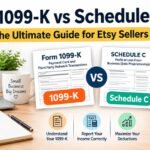
Etsy will issue Form 1099-K only when a seller reaches $20,000 in gross sales and 200 transactions in 2026. The IRS confirmed this threshold after the One Big Beautiful Bill restored the older reporting rule. Both conditions must be true. Sell $25,000 with only 150 transactions, and you still will not get the form.
This point trips up many sellers: you owe tax on your Etsy income even if you never receive a 1099-K. The form only helps the IRS match reported income against tax returns. Your duty to report income exists regardless of any form.
The 1099-K also shows numbers that look larger than your real profit. It reports the total buyers paid, including shipping charges. Etsy fees, refunds, and returns are not deducted. You must make these adjustments yourself when you file your return.
Maintain a sales log throughout the year. You should not rely solely on the 1099-K. A clean spreadsheet protects you if numbers ever look mismatched.
Sales Tax vs. Income Tax: Two Different Things
Many sellers confuse sales tax with income tax. These are two separate systems, and Etsy treats them differently.
Sales tax applies to the buyer, not the seller. States require merchants to collect this tax on taxable goods. Etsy automatically collects and sends sales tax to most states on your behalf. This process is called marketplace facilitator tax collection. Etsy transactions do not require separate sales tax returns.
However, do not assume Etsy covers every state or every situation. Some states have unique rules. If you also sell through other channels, like your own website or in-person markets, you may need to register and collect sales tax there yourself.
Income tax is different. You, the seller, are subject to this tax based on your profit. The federal government and most states charge income tax on your Etsy earnings. This tax is not paid by Etsy. You calculate and pay it yourself using Schedule C and your personal tax return.
Tax Type
Who Pays
Who Collects
Etsy’s Role
Sales tax
Buyer
State government
Etsy collects and remits automatically
Income tax
Seller
IRS and state tax agency
Etsy does not pay this for you
Self-employment tax
Seller
IRS
Etsy does not pay this for you
Understanding this split helps you avoid confusion at tax time. Sales tax rarely needs your attention. Income tax and self-employment tax always need your attention.
Quarterly Estimated Taxes for Etsy Sellers
The United States runs on a pay-as-you-go tax system. This means the IRS expects payments throughout the year, not just once in April.
If you expect to owe $1,000 or more in combined income tax and self-employment tax for the year, you likely need to pay quarterly estimated taxes. Many active Etsy sellers fall into this group.
You pay these quarterly taxes using Form 1040-ES. The IRS sets four due dates each year, roughly in April, June, September, and January. Missing these dates can trigger penalties, even if you pay your full tax bill in April.
To estimate your payment, you can use two simple methods:
Prior-year method: Base your payment on last year’s tax bill, divided into four parts.
Current-year method: Estimate this year’s profit, subtract expenses, then calculate the tax owed.
New sellers often underestimate this step. A shop that grows fast in its first year can face a large tax bill in April, along with a penalty for underpayment. Setting aside a portion of each sale, often 25% to 30%, helps you stay prepared.
Deductions That Lower Your Etsy Tax Bill
Business sellers can claim many deductions. These deductions reduce your taxable profit, which lowers both income tax and self-employment tax.
Common deductions include:
Materials and supplies used to make your products
Etsy fees, including listing fees, transaction fees, and payment processing fees
Shipping costs, including labels and packaging materials
Home studio costs, if you use part of your home only for your shop
Equipment, such as sewing machines, cameras, or computers
Advertising costs, including Etsy Ads and social media promotion
Mileage, when you drive for supply runs or craft fairs
The IRS requires that these expenses stay ordinary and necessary. This means the cost must fit your type of business and must support your shop’s operation.
Keep receipts and records for every deduction. A separate business bank account makes this process much easier. It keeps your Etsy income and expenses apart from personal spending, which protects you during an audit.
Recordkeeping Tips for Etsy Sellers
Good records make tax season easier. They also protect you if the IRS ever questions your return. Most Etsy sellers benefit from a simple, consistent system rather than a complex one.
Start with a separate bank account for your shop. Mixing personal and business money creates confusion when you calculate profit. A dedicated account also makes deductions easier to prove.
Next, track every sale and every expense as it happens. Do not wait until December. A simple spreadsheet works well for most small shops. List the date, amount, buyer, and category for each transaction. Etsy’s own Shop Manager and Finances tab already store much of this data, so check those tools each month.
Save receipts for every business purchase. Digital copies work fine. Photograph paper receipts and store them in a labeled folder online. The IRS generally expects you to keep records for three years after you file a return, though some situations call for longer.
Consider using accounting software built for small sellers. Many tools sync directly with Etsy and separate your fees, shipping costs, and sales tax automatically. This step saves hours during tax season and lowers the chance of costly mistakes.
Finally, review your numbers each quarter, not just once a year. Quarterly check-ins help you estimate taxes accurately and catch errors early, long before they turn into bigger problems.
Do You Need an LLC to Sell on Etsy?
Many sellers ask whether they need to form a Limited Liability Company (LLC) before they owe taxes. The answer is no. Tax rules apply to you whether you operate as a sole proprietor or through a formal business structure.
Most Etsy sellers start as sole proprietors by default. This structure requires no paperwork to begin. You simply report your Etsy income and expenses on Schedule C using your own Social Security number.
An LLC adds a legal layer between your personal assets and your business debts. It does not change how the IRS taxes your profit in most cases. A single-member LLC still reports income the same way a sole proprietor does, unless the owner elects a different tax status.
Sellers often form an LLC once their shop grows larger or carries more risk. Reasons include protecting personal savings, building credibility with wholesale buyers, or preparing to bring on a business partner. A small, part-time shop rarely needs this step right away.
Talk to a tax professional or attorney before you decide. They can review your specific situation and recommend the right structure for your goals.
Conclusion
Yes, you have to pay taxes on Etsy sales. This rule applies whether you run a small hobby shop or a full-time business. The IRS taxes your profit, tracks your income through Form 1099-K when you cross certain limits, and expects quarterly payments once your tax bill grows large enough.
The good news is that you control much of this process. Track your income and expenses carefully. Know the difference between sales tax and income tax. Claim every valid deduction. Set aside money for quarterly payments. These simple habits keep you compliant and reduce stress when tax season arrives.
If your shop grows quickly or your tax situation feels complex, a tax professional can help you file correctly and find deductions you may have missed.
Do I have to pay taxes on Etsy sales if I only made a small profit?
Yes. The IRS taxes all profit, even small amounts. There is no minimum sales limit that exempts you from reporting income.
What happens if I don’t receive a Form 1099-K from Etsy?
You still must report your full Etsy income. The 1099-K only helps the IRS match income to tax returns. Your reporting duty exists with or without this form.
Does Etsy pay sales tax for me?
Etsy collects and sends sales tax to most states automatically through marketplace facilitator laws. This system covers most Etsy transactions, but it does not cover your income tax or self-employment tax.
How much money can I make on Etsy before I owe self-employment tax?
You owe self-employment tax once your net profit reaches $400 in a year. This threshold is low, so most active sellers cross it.
Can I deduct my Etsy shop expenses if I treat it as a hobby?
No. Hobby sellers cannot deduct expenses like materials or shipping. Only sellers who qualify as a business can claim these deductions on Schedule C.
Disclaimer
This article is for general information only. It is not tax or legal advice. Tax rules change often, so confirm current details with the IRS or a licensed tax professional before you file.
Author Bio
About Team Tax Nookly
Team Tax Nookly is a dedicated group of bookkeeping professionals and e-commerce tax specialists focused exclusively on the Etsy marketplace. We simplify complex tax regulations and provide actionable financial strategies to help Etsy sellers manage their businesses with complete confidence.









1 thought on “Do I Have to Pay Taxes on Etsy Sales? Full 2026 Guide”