Etsy Business Expenses List: What Sellers Can Deduct
October 10, 2026
Written By team taxnookly
Our goal is to provide reliable, helpful, and up-to-date content based on practical tax and bookkeeping principles.
Quick answer: Your Etsy business expenses list includes costs you pay to make, sell, and ship your products. Common examples are materials, Etsy fees, shipping, packaging, ads, software, and the business share of mixed-use items. A cost must be ordinary (common in your trade) and necessary (helpful for your shop). Personal costs don’t count. Keep a receipt or record for each one.
An Etsy business expenses list helps you subtract real costs from your sales. That leaves a smaller profit to tax. This guide shows which costs usually qualify, which need extra care, and how to track them without a headache.
For the bigger picture, including which expenses may qualify and how deductions affect your taxes, read our complete Etsy tax deductions guide.
We cover federal rules only. Your state may treat some costs differently.
What counts as a business expense for an Etsy seller?
A business expense (a cost you pay to run your shop) lowers your taxable profit. The IRS uses a simple test. The cost must be ordinary and necessary.
Ordinary means other sellers in your line of work pay similar costs. Necessary means the cost helps your shop earn money. It doesn’t have to be essential.
Here’s what trips up many sellers: you can’t deduct a cost just because it feels business-related. Buying a new sweater to wear in your product photos probably fails the test. Buying a backdrop and a light box for those photos passes it.
Your shop also needs to be a real business, not a hobby. The IRS looks at things like profit motive and how you run the shop. If you’re unsure which side you’re on, a tax professional can help you decide.
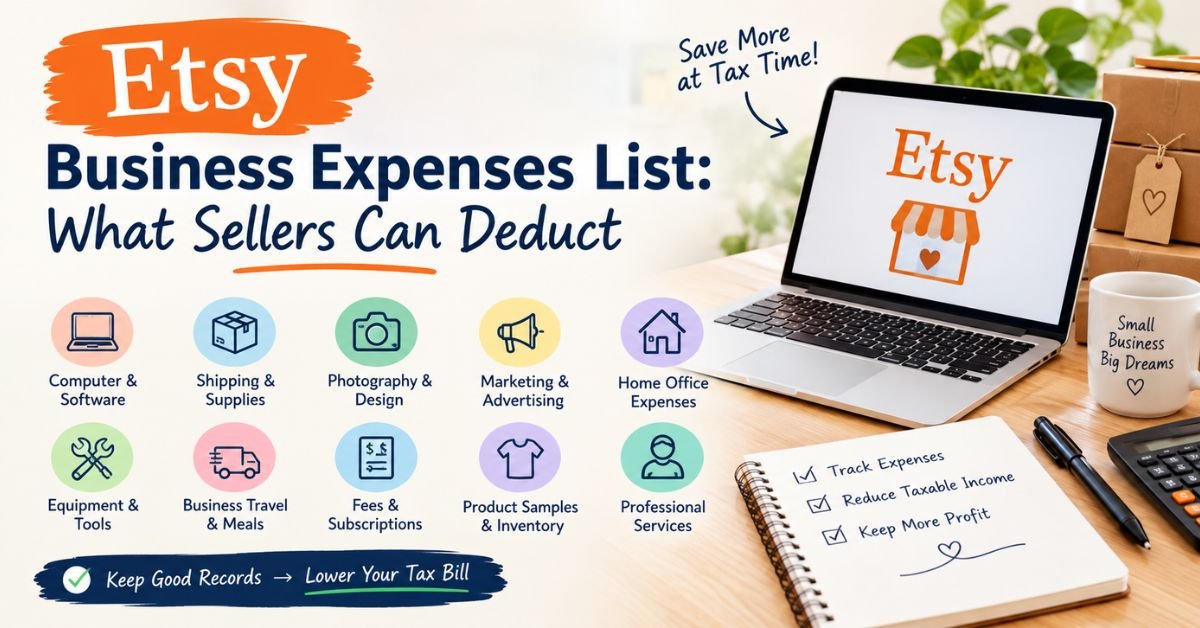
The Etsy business expenses list by category
Use this table as a starting checklist. Not every cost fits every shop.
Category
Common examples
Watch out for
Materials and supplies
Fabric, beads, wax, paper, ink, packaging
Keep supplies you used separate from supplies you still hold
Etsy and payment fees
Listing, transaction, and payment processing fees, ad fees
Use your Etsy statements, not just your bank deposits
Shipping
Postage, labels, boxes, mailers, tape
Postage you charge buyers is income; postage you pay is an expense
Software and tools
Design apps, bookkeeping software, photo editors
Subscriptions you use for personal projects too
Marketing
Social ads, business cards, product photos, samples
Gifts and giveaways may have limits
Equipment
Printers, cutters, sewing machines, cameras
Larger purchases may follow special rules
Professional help
Tax preparer, bookkeeper, designer
Only the business part of the fee
Other business costs
Business license, bank fees on a business account
Personal accounts mix business and personal costs
Cost of goods sold and other expenses
Cost of goods sold (the direct cost of making the items you sold) works a little differently from other expenses. Materials, supplies built into your products, and similar direct costs usually belong here.
Everything else, such as software, ads, and fees, usually counts as an ordinary business expense.
How you report each group depends on your setup. If you hold a lot of unsold inventory, the rules get more detailed. We’d ask a qualified tax professional before you decide how to handle it. Check the current IRS instructions for Schedule C (the form most sole-proprietor sellers use to report business income and expenses) for the current-year treatment.
Expenses that need extra care
Some costs sit in a gray zone. They can qualify, but limits and records matter.
Home office. You may deduct part of your home costs if you use a space regularly and exclusively for the business. A kitchen table you also eat at usually doesn’t meet that test. Check the current figure and method on IRS.gov.
Car and mileage. Driving to buy supplies or ship orders can qualify. Commuting and personal trips don’t. You need a log. Check the current mileage rate on IRS.gov.
Meals. Meals have special limits and conditions. Check the current rules on IRS.gov before you deduct any.
Phone and internet. Deduct only the business share. If you use your phone half the time for the shop, 50% is a reasonable starting point to document.
Startup costs. Costs you pay before you open can follow different timing rules. Check the current rules and limits on IRS.gov.
Business gifts. Limits apply. Check the current figure on IRS.gov.
When a cost serves both business and personal use, split it. Write down how you chose the split. A simple note is better than a guess you can’t explain later.
What you can’t deduct on your Etsy business expenses list
Some costs never belong on the list:
Personal groceries, clothes, and entertainment.
You move your own pay from the business to yourself.
Federal income tax and self-employment tax (the Social Security and Medicare tax that self-employed people pay).
Loan principal (the part of a payment that repays the amount you borrowed). Interest on a business loan may qualify.
Fines and penalties.
Anything you can’t tie to the business.
Sales tax is also a separate topic. Sales tax rules come from your state, and they differ by state. Don’t assume a federal rule covers it.
A worked example with simple math
Illustrative example, not real data. Say a shop sells handmade candles. The numbers below are made up to show the steps.
The shop’s net profit (sales minus allowed expenses) is $10,360 in this example. That’s the number the shop reports, not the full $18,000. Without good records, the owner might miss part of the $7,640 and pay tax on more profit than needed.
This example skips tax rates on purpose. Check the current self-employment tax rate and income tax brackets on IRS.gov for your tax year.
How to track your Etsy business expenses
You don’t need fancy tools. You need a habit.
Simple tracking checklist:
Open a separate bank account and card for the shop.
Save every receipt as a photo or PDF on the day you get it.
Download your Etsy sales and fee reports on a regular schedule.
Log mileage on the day you drive.
Label each cost with a category from the table above.
Review the list once a month.
A spreadsheet works fine for most small shops. Bookkeeping software can save time as your orders grow. Habits matter more than tools.
Keep your records long enough to support your return. Check the current record-keeping period on IRS.gov.
Federal rules vs. state rules
Everything above describes federal income tax and self-employment tax. Your state may add its own rules. Some states tax income differently. Many states and cities also have their own sales tax rules for online sellers.
Check your state tax agency’s website for your state’s rules. If you sell in several states, a local tax professional can save you time.
When to ask a tax professional
A CPA (certified public accountant) or enrolled agent (a tax pro authorized by the IRS to represent taxpayers) can help when:
You hold a lot of unsold inventory.
You bought expensive equipment.
You use a room at home for the shop.
You sell in several states.
You can’t tell if your shop counts as a business or a hobby.
A short consultation costs less than fixing a mistake later.
Frequently Asked Questions
What can I write off as an Etsy seller?
You can usually write off ordinary and necessary costs of running your shop. That includes materials, Etsy fees, shipping, packaging, software, and ads. You can’t write off personal costs. Mixed-use items need a business-share split, and some costs have special limits, so check IRS.gov.
Do I need receipts for every expense?
Keep a record for every cost you deduct. A receipt is best. Bank or card statements help but may not show what you bought. For small or unusual costs, write a short note about the business reason. Check IRS.gov for the current record-keeping rules.
Are Etsy fees tax deductible?
Etsy fees usually count as business expenses. That includes listing fees, transaction fees, payment processing fees, and ad fees. Use your Etsy statements to find the exact totals. Bank deposits show only what Etsy paid you after fees, so they don’t tell the full story.
Can I deduct supplies I bought but haven’t used yet?
Not always. Unsold inventory and unused supplies can follow different rules than items you’ve already used in products you sold. The treatment can depend on your setup. A qualified tax professional can tell you how to handle yours.
Not tax advice
This article gives general information about U.S. federal tax rules. It isn’t tax, legal, or accounting advice, and it doesn’t cover your exact facts. Rules change and differ by state. Check the current rules on IRS.gov or ask a CPA or enrolled agent before you file.
Your 10-Minute Homework
Open your bank or card statement from last month and mark every shop-related charge with one category from the table above. Then write the total for each category in a simple spreadsheet. You’ll have your first expense log, and you’ll see which costs you’ve been missing.
Team Tax Nookly is a dedicated group of bookkeeping professionals and e-commerce tax specialists focused exclusively on the Etsy marketplace. We simplify complex tax regulations and provide actionable financial strategies to help Etsy sellers manage their businesses with complete confidence.








1 thought on “Etsy Business Expenses List: What Sellers Can Deduct”