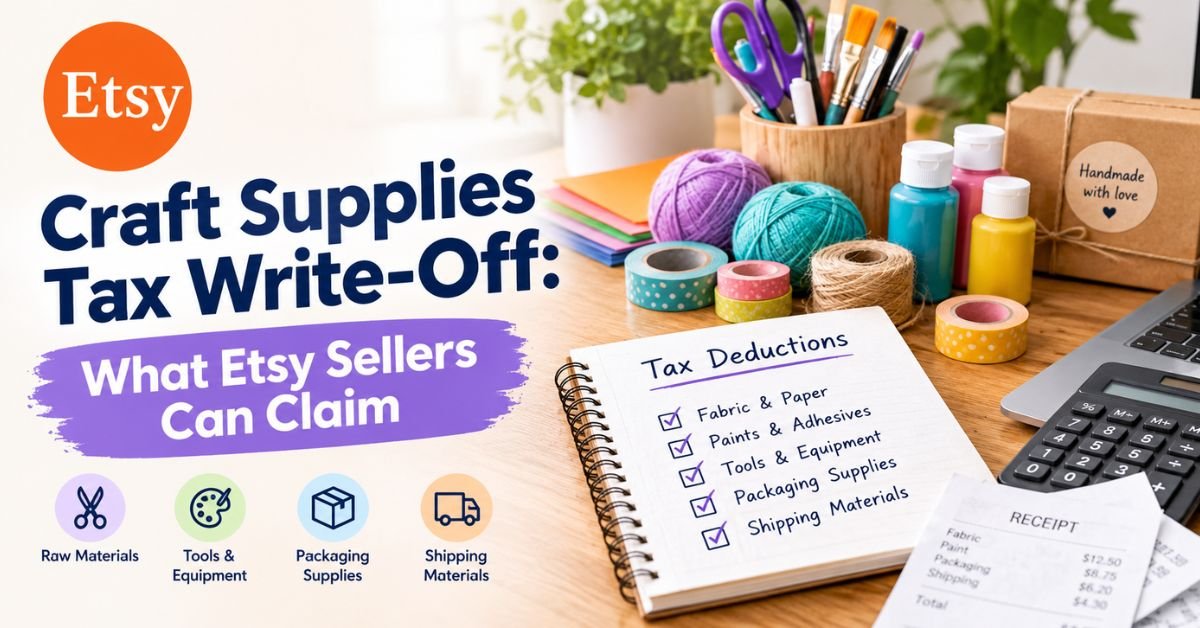
Craft Supplies Tax Write-Off: What Etsy Sellers Can Claim
October 20, 2026
Written By team taxnookly
Our goal is to provide reliable, helpful, and up-to-date content based on practical tax and bookkeeping principles.
Running an Etsy shop means wearing a dozen different hats: maker, photographer, marketer, customer service manager, and yes-bookkeeper.
When tax season rolls around, one of the first questions most makers ask is: “Can I write off all these craft supplies I bought?”
The short answer is yes-if you run your shop as a business, you can deduct the cost of your supplies.
Craft supplies are only one part of the picture. Our complete guide to Etsy tax deductions covers other common write-offs, including Etsy fees, shipping, packaging, home office costs, and equipment.
However, the IRS doesn’t treat every ribbon, jar, or piece of fabric the same way. The trick is knowing where to put each expense so you don’t end up overpaying taxes or raising red flags on your return.
Let’s break down how craft supply tax deductions work for Etsy sellers, where most people get tripped up, and how to organize your records without losing your mind.
A tax write-off (or business deduction) is simply an expense you subtract from your shop’s revenue to calculate your actual profit. You only pay income tax on the profit that remains.
When you sell on Etsy as a sole proprietor in the US, your business income and expenses are reported on IRS Schedule C (Form 1040). Your net profit from Schedule C then flows to:
Schedule 1 (Form 1040): Line 3 (for federal income tax).
Schedule SE (Form 1040): Line 2 (to figure out your self-employment tax for Social Security and Medicare).
Because every dollar in valid business expenses lowers your net profit, writing off your craft supplies legally reduces both your income tax and your self-employment tax.
>Note:This guide focuses on US federal tax rules. State income taxes and local sales tax rules vary, so always double-check with your state’s department of revenue.
Materials vs. Supplies: The Two Different Buckets
The biggest mistake Etsy sellers make is dumping all their receipts into one single “supplies” category. The IRS actually breaks craft expenses into two separate categories on Schedule C:
1. Bucket 1: Materials (Cost of Goods Sold – COGS)
Materials are items that become part of the final product you sell.
These do not go directly under general expenses on Schedule C. Instead, they fall under Cost of Goods Sold (COGS) in Part III (Line 38 & Line 42). You can learn more directly from the official IRS Publication 334: Tax Guide for Small Business.
Crucial Catch: You can only deduct the cost of materials for items you actually sold during the tax year. Unsold inventory sitting on your shelves at the end of December cannot be written off until it sells.
2. Bucket 2: General Business Supplies
These are items you use up while running your shop, but they don’t go into the product itself.
These get reported under Supplies in Part II (Line 22) of Schedule C. Unlike materials, you can generally deduct these in the year you buy them.
Quick Reference Cheat Sheet
Expense / Item
Where it Goes
Why
Wax, wicks, yarn, beads, fabric, blank shirts
Materials (COGS – Part III)
They become part of the actual product.
Shipping boxes, poly mailers, labels, tape, ink
Supplies (Part II)
Used for packaging and admin, not in the product.
Sandpaper, glue, cleaning rags used in crafting
Either Bucket
Counted as direct/indirect production costs. Pick one method and stay consistent.
Cricut, sewing machine, kiln, heat press
Equipment / Assets
These are durable tools, not consumable supplies.
A Simple Example: The Candle Shop Math
Let’s walk through how this works in real life so you can see why year-end inventory counting matters.
Imagine Sarah runs an Etsy candle shop:
She enters the year with $400 in leftover wax and jars.
She buys $3,200 worth of new materials during the year.
At the end of December, she counts her remaining unused wax and unsold candles and values them at $700 at cost.
She made $9,000 in total sales.
She also spent $240 on shipping labels, tissue paper, and tape.
Here is how her deductions look:
Total Materials Available: $400 (Beginning) + $3,200 (Bought) = $3,600
Cost of Goods Sold (COGS): $3,600 − $700 (Unsold Ending Inventory) = $2,900
General Supplies:$240
Total Deductions: $2,900 + $240 = $3,140
Sarah’s Taxable Profit Calculation:
Gross Sales: $9,000
Less COGS: −$2,900
Less Supplies: −$240
Net Profit:$5,860
If Sarah had forgotten to count her year-end inventory and just wrote off the full $3,200 of raw purchases, she would have incorrectly claimed $300 too much in deductions—which could cause issues in an audit.
What Happens When You Use Supplies for Personal Projects?
It’s common for crafters to buy yarn, fabric, or vinyl in bulk, using some for Etsy products and keeping some for personal gifts or hobbies.
The IRS rule is clear: You can only deduct the business percentage.
Example: You buy $120 of fabric. You use 75% for Etsy orders and 25% to make a blanket for a family member.
Business Deduction: $90
Personal Expense: $30 (Not deductible)
Keep a quick notebook or digital log whenever you split bulk materials so you have proof of your calculation.
Business vs. Hobby: Does Your Etsy Shop Qualify?
To claim craft supply write-offs, the IRS requires that your shop operates as a legitimate business, not just a hobby.
Generally, the IRS looks at whether you operate with an intent to make a profit. You can review the official IRS Hobby vs. Business Guidelines to check where your shop falls.
Signs of a business include:
Keeping detailed records and receipts.
Pricing items to generate profit.
Spending regular time and effort on your shop.
If the IRS classifies your shop as a hobby, your ability to write off expenses is extremely limited under current tax laws.
Smart Records to Keep for Tax Season
If the IRS ever asks questions, having clean records turns guesswork into an easy conversation. Check the official IRS Recordkeeping Rules for Small Businesses and make sure you retain:
Digital Receipts: Photos or PDF copies of all supplier invoices and order confirmations.
Clear Itemization: Bank statements show the amount, but receipts show what you actually bought.
Year-End Inventory Count: A spreadsheet showing your unsold materials and products as of December 31st.
Separate Business Bank Account: Keeping business and personal funds separate makes tax prep ten times easier.
When to Consult a Tax Professional
Tax rules change, and every maker’s situation is unique. Consider working with a CPA or Enrolled Agent (EA) if:
You hold a significant amount of unsold inventory.
You bought expensive equipment (like laser cutters or industrial machines).
You sell internationally or handle complex multi-state sales tax.
Your Etsy shop transitioned from a side hustle to a full-time business this year.
Frequently Asked Questions
Can I write off craft supplies I bought but haven’t used yet?
Generally, no. Unused materials remain part of your ending inventory and roll over to the following year. They only become deductible through COGS when the finished product sells.
Are bank statements enough, or do I need receipts?
A bank statement shows that money left your account, but it doesn’t prove what was purchased. Always save the itemized order confirmation or store receipt alongside your bank records.
Can I claim expenses if my Etsy shop lost money this year?
Yes, legitimate businesses can report a net loss on Schedule C. However, reporting losses multiple years in a row may cause the IRS to review whether your shop is a business or a hobby.
💡 Your 10-Minute Action Item
Open your purchase history for the last 30 days. Create a quick spreadsheet and tag each order with an “M” for raw product materials or an “S” for general packing and admin supplies. Starting this habit now will save you hours of stress come tax season!
Disclaimer
Tax Nookly provides educational content for informational purposes only and does not constitute formal tax, legal, or accounting advice. Always verify details directly onIRS.govand consult a qualified tax professional regarding your specific tax situation.
Author Bio
About Team Tax Nookly
Team Tax Nookly is a dedicated group of bookkeeping professionals and e-commerce tax specialists focused exclusively on the Etsy marketplace. We simplify complex tax regulations and provide actionable financial strategies to help Etsy sellers manage their businesses with complete confidence.








1 thought on “Craft Supplies Tax Write-Off: What Etsy Sellers Can Claim”