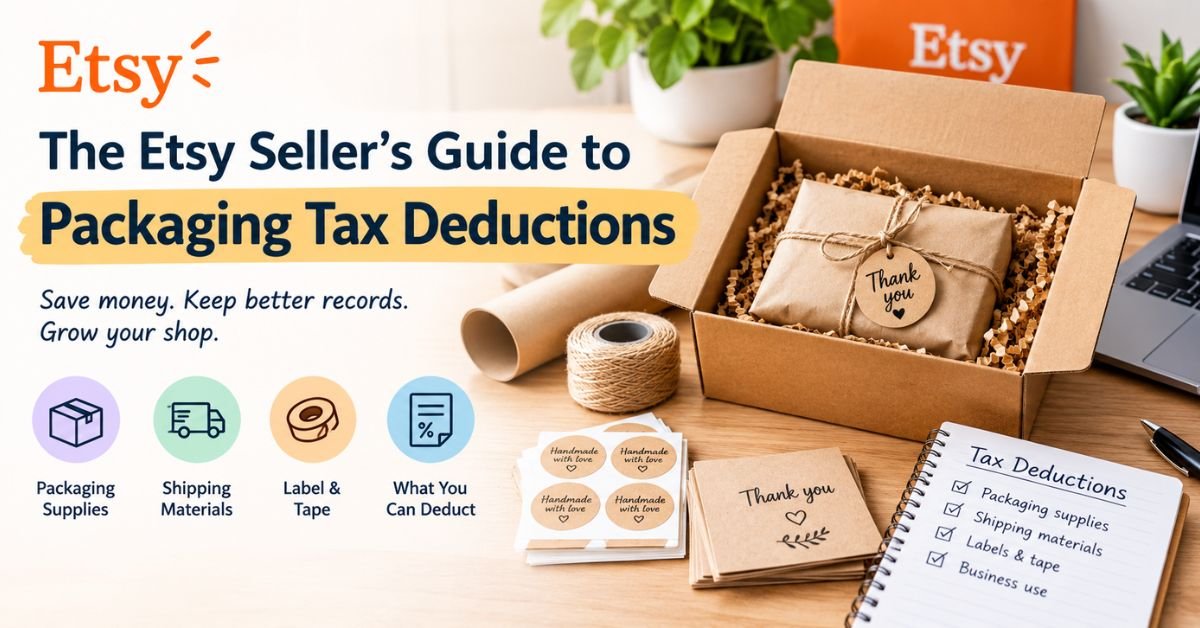
The Etsy Seller’s Guide to Packaging Tax Deductions
October 22, 2026
Written By team taxnookly
Our goal is to provide reliable, helpful, and up-to-date content based on practical tax and bookkeeping principles.
Quick Summary: Yes, you can absolutely deduct the cost of packaging materials you purchase for your Etsy shop! Essential items like poly mailers, cardboard boxes, tape, and shipping labels directly lower your net business income as supplies expenses on Schedule C. However, if the packaging is an integral part of the product itself (like a custom jewelry box or candle tin), it generally belongs under Cost of Goods Sold (COGS).
Knowing where to categorize each item ensures you maximize your legitimate tax savings while keeping your bookkeeping clean, audit-proof, and accurate.
Navigating tax season as a small business owner can feel overwhelming, but claiming the Etsy packaging deduction is one of the easiest ways to keep more of your hard-earned profits. Every box, sheet of bubble wrap, and printed shipping label adds up over the course of a year, directly reducing your taxable income.
However, a deduction only works in your favor if you categorize it correctly. Putting shipping supplies on the wrong line of your tax form won’t invalidate your expense, but keeping clear categories makes your books easier to read and simpler to manage.
Packaging is only one part of the costs Etsy sellers may be able to deduct. For a broader checklist covering Etsy fees, shipping, craft supplies, home office costs, mileage, and equipment, read our complete Etsy tax deductions guide.
What Packaging Expenses Can You Actually Write Off?
Almost every physical item you buy to package, wrap, and ship your Etsy orders qualifies as a legitimate business expense. The main distinction isn’t whether you can deduct it, but how it should be categorized on your tax forms.
Here is a quick breakdown to help you sort your packaging receipts:
These items protect and ship the product. The buyer isn’t purchasing the box itself; they are paying for what’s inside.
Decorative tins, jars, bottle containers, branded gift boxes
Cost of Goods Sold (COGS)
Packaging is an integral part of the end product.
Tissue paper, logo stickers, branded ribbon, thank-you cards
Supplies or Presentation Expense
These enhance your customer unboxing experience. Pick one consistent accounting rule and stick with it each year.
Marketing flyers, promotional inserts, business cards
Advertising / Marketing
These are designed to bring in repeat sales or promote your shop rather than package the physical item.
Postage & shipping labels (USPS, UPS, FedEx fees)
Shipping / Freight Expenses
This pays for the delivery service itself, not the physical packaging materials.
Pro Tip: Consistency is key with IRS rules. For gray-area items like tissue paper or branded stickers, decide whether you want to treat them as shipping supplies or marketing presentation costs, write down your choice, and apply that same rule every single tax year.
Where Does Packaging Go on Schedule C?
When filing as a sole proprietor or single-member LLC, two main sections of Schedule C (Form 1040) handle your packaging purchases:
1. Supplies Expense (Line 22)
Outer shipping packaging—such as mailing envelopes, packing peanuts, bubble wrap, and shipping tape—typically lands under Supplies (not included in Part III) on Line 22. These are everyday consumable items used to fulfill orders.
2. Cost of Goods Sold (Part III)
If you sell items inside special product packaging (like a printed box for a custom mug or a tin for body lotion), that packaging is part of your inventory direct costs. You account for these costs in Part III (Cost of Goods Sold), where ending inventory adjustments are calculated before the final figure flows to Page 1.
If your shop made $2,000 in net profit before counting packaging, deducting these valid expenses brings your taxable business earnings down to $1,700 ($\$2,000 – \$300$). Lowering your net earnings also lowers the base for Self-Employment Tax (Social Security & Medicare), saving you money on multiple fronts!
A Quick 3-Step Decision Test
Whenever you buy a new batch of packaging supplies, run the purchase through these three simple questions:
Is it part of the item the customer pays to keep? Examples: Candle tins, jewelry gift boxes, custom spice jars.
👉 Category:Cost of Goods Sold (COGS)
Does it exist solely to transport and protect the order? Examples: Padded mailers, cardboard boxes, packing tape, address labels.
👉 Category:Supplies Expense
Is it designed to promote future business or show appreciation? Examples: Coupon cards, promotional stickers, catalog inserts.
👉 Category:Advertising / Marketing Expense
How to Track Your Packaging Costs Year-Round
Keeping clean records throughout the year makes tax prep effortless and protects you in case of a tax audit or review.
Save digital copies of all receipts: Download receipts from Etsy, Amazon, Uline, or local craft stores immediately upon purchase.
Maintain dedicated accounts: Keep personal purchases completely separate from your business bank account or credit card.
Categorize at purchase: Tag each transaction in your bookkeeping software as either “Shipping Supplies” or “Product Packaging.”
Perform an end-of-year inventory check: If you buy product boxes or tins in bulk, count what remains on December 31st so you can accurately report ending inventory.
Document your accounting rules: Write down a simple note explaining how you classify items like tissue paper or stickers so your method remains consistent year after year.
For additional online seller tax resources and quarterly filing advice, check out the official IRS Gig Economy Tax Center.
Frequently Asked Questions (FAQs)
Can I deduct packaging expenses if my Etsy shop operated at a loss?
Yes. Legitimate business expenses can generally be claimed even if your shop didn’t make a profit overall. However, make sure your shop is operated as an active business with the intent to earn a profit, rather than a hobby. Consult IRS Publication 334 for guidelines on distinguishing business activities from hobbies.
Do I deduct packaging when I pay for it or when I ship the order?
If you use cash-basis accounting (which most small Etsy sellers do), you generally deduct shipping supplies in the year you pay for them. However, product containers that count as inventory (COGS) are usually deducted when the finished item is actually sold.
Are shipping labels and actual postage fees the same deduction?
No. Blank thermal labels or paper labels are classified as shipping supplies. The fee you pay to USPS, UPS, or Etsy for the actual postage/shipping service is categorized separately under Shipping & Postage Expenses.
Does Etsy automatically track my packaging expenses for me?
No. Etsy tracks your gross sales, listing fees, transaction fees, and shipping labels purchased directly through their platform. They cannot see what you spend at external stores or suppliers for boxes, mailers, or custom packaging. You must track those expenses independently.
Conclusion
Managing your Etsy business packaging deductions doesn’t have to be complicated. By separating outer shipping mailers from core product packaging and keeping steady receipts throughout the year, you can confidently claim every dollar you deserve on Schedule C.
Taking just a few minutes each month to organize your supplies expenses will keep your books stress-free, protect your shop during tax season, and leave more money in your bank account to grow your creative business!
Disclaimer
This article gives general federal tax information for small sellers. It isn’t tax advice for your situation. If you keep inventory, own a business with a partner, sell in several states, or feel unsure about a line, talk to a CPA or enrolled agent before you file.
Author Bio
About Team Tax Nookly
Team Tax Nookly is a dedicated group of bookkeeping professionals and e-commerce tax specialists focused exclusively on the Etsy marketplace. We simplify complex tax regulations and provide actionable financial strategies to help Etsy sellers manage their businesses with complete confidence.







1 thought on “The Etsy Seller’s Guide to Packaging Tax Deductions”