Etsy Hobby vs Business Tax: Full 2026 Guide for Sellers
September 2, 2026
Written By team taxnookly
Our goal is to provide reliable, helpful, and up-to-date content based on practical tax and bookkeeping principles.
In this guide, our team at Tax Nookly will show you step-by-step how to figure out if your Etsy shop counts as a hobby or a business , and why that answer changes your entire tax bill.
Here’s the short version: the IRS taxes hobby income and business income very differently. Business sellers get real deductions. Hobby sellers mostly don’t. Getting this wrong costs you money. Let’s fix that.
What Does “Hobby vs Business” Mean for Etsy Sellers?
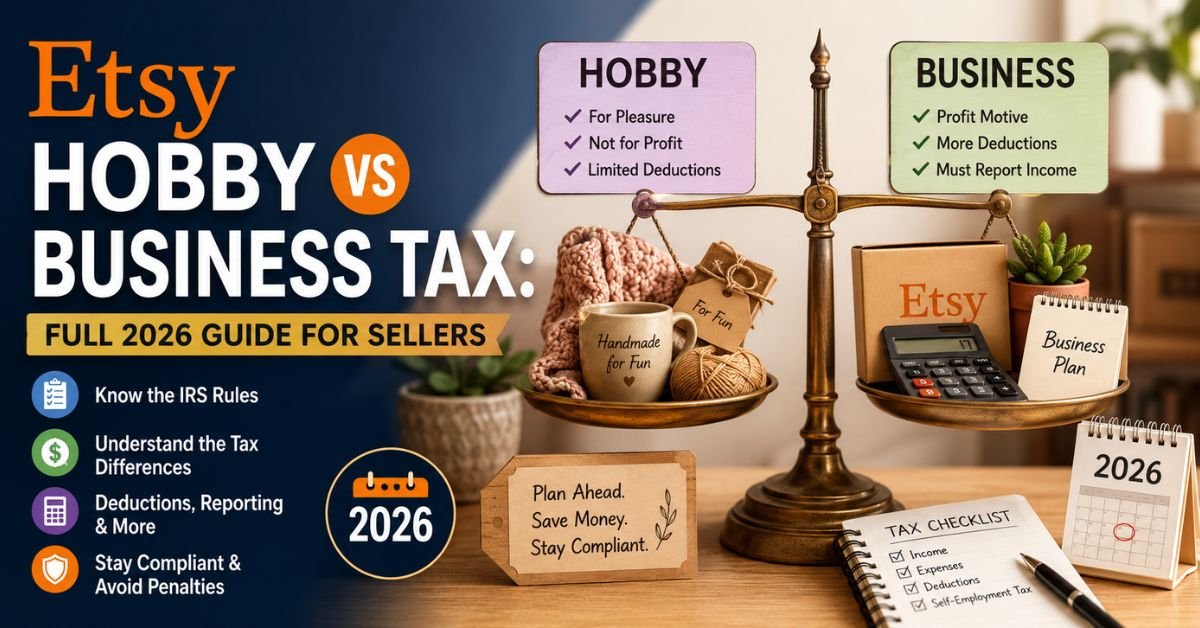
The IRS splits income earners into two groups: hobbyists and business owners. A hobby is something you do for fun, without depending on the income. A business is run to make money, with sales tracking and growth plans.
This split changes your tax treatment. The IRS taxes both types of income, but treats expenses very differently. Business owners can subtract most costs before they pay tax. Hobby sellers cannot.
Many new Etsy sellers start as hobbyists selling handmade goods as a side project. As sales grow, the IRS may expect a switch to business reporting. Waiting too long can cost you money at tax time.
How the IRS Decides: Hobby or Business?
The IRS does not use one single rule to sort hobby sellers from business sellers. Instead, it looks at your full situation. This is often called a facts-and-circumstances test.
The 9-Factor Profit Test
The IRS checks several factors under Internal Revenue Code Section 183, often called the hobby loss rule. None of these factors decide things alone. The IRS weighs them together:
Do you run the shop in a businesslike way? (Records, bank account, business plan)
Do you or your advisors have the skill needed to succeed?
How much time and effort do you put in?
Do you expect your Etsy supplies or equipment to grow in value?
Have you succeeded at similar activities before?
What is your history of profit or loss in the shop?
How much profit do you actually make, when you do make one?
Do you depend on this income to live?
Is there strong personal pleasure involved, with little profit motive?
The 3-of-5-Year Profit Rule
The IRS also uses a simpler shortcut. If your Etsy shop shows a profit in three of the last five tax years, the IRS presumes you run a business. This shifts the burden of proof. Instead of you proving you’re a business, the IRS must prove you’re not. This rule gives sellers a useful safe harbor to aim for.
Etsy Hobby vs Business Tax: Key Differences at a Glance
The table below shows how hobby vs business tax treatment differs for Etsy sellers.
Tax Factor
Hobby Seller
Business Seller
Report income on
Schedule 1 (Form 1040)
Schedule C (Form 1040)
Self-employment tax
Not owed
Owed on net profit over $400
Expense deductions
Very limited; capped under current law
Fully deductible ordinary business costs
Loss deductions
Cannot deduct a net loss
Can deduct a loss against other income
QBI deduction (Section 199A)
Not eligible
Eligible, up to 20% of net income
Retirement account options
Not eligible from this income
Eligible (SEP IRA, Solo 401k)
Audit risk if inconsistent
Low, but limited upside
Higher, but rewards good records
The biggest difference is simple: business sellers get real deductions. Hobby sellers pay tax on close to their full gross income, with almost nothing to subtract.
Do You Still Owe Tax Without a 1099-K?
Many Etsy sellers assume no 1099-K means no tax owed. This is not true. Etsy issues Form 1099-K once you cross $20,000 in gross sales and 200 transactions in a year, a threshold restored for 2025 and 2026. Your duty to report income starts at $1 in profit, form or no form.
Even a small hobby seller with $500 in profit must report that income on their tax return. The IRS may not have a matching form to check it against — but skipping this step still counts as underreporting.
If you earn $400 or more in net self-employment profit, you also owe self-employment tax. This covers Social Security and Medicare. Hobby income never triggers this tax, but it also never builds your Social Security record.
Tax Forms: Hobby Sellers vs Business Sellers
Your Etsy income lands on a different form depending on your status.
Filing Detail
Hobby Filers
Business Filers
Main form
Schedule 1, Line 8j
Schedule C
Expense form
None allowed against this income
Part II of Schedule C
Self-employment tax form
Not filed
Schedule SE
Estimated quarterly taxes
Rarely required
Often required
Business sellers file Schedule C. This form lists your gross sales, then subtracts expenses like materials, Etsy fees, and shipping. What’s left is your net profit – the number the IRS actually taxes.
Business sellers file Schedule C. This form lists their gross sales, then subtracts expenses like materials, Etsy fees, and shipping. What’s left is their net profit – the number the IRS actually taxes. For a complete overview of Etsy income, deductions, tax forms, and recordkeeping, see our [ultimate guide to Etsy seller taxes].
Hobby sellers report gross income on Schedule 1. There is no expense section to offset that income. This is why the hobby label can cost real money once sales grow.
What Can You Deduct as a Business? What about hobbies?
This section decides who saves money. Business owners can deduct a long list of costs.
Common Etsy business deductions include:
Materials and supplies used to make products
Etsy listing fees, transaction fees, and payment processing fees
Shipping costs and packaging
A portion of your home used as a workspace
Mileage for supply runs or shows, at the IRS standard rate
Software subscriptions used to run your shop
Advertising, including Etsy Offsite Ads fees
Hobby sellers face a much harder rule. Current tax law removed most hobby expense deductions. A hobby seller generally pays tax on gross hobby income with no offsetting write-offs. Business sellers may also qualify for the Qualified Business Income deduction, worth up to 20% of net profit — another reason to establish business status early.
How to Prove Your Etsy Shop Is a Business
You do not need a fancy LLC to count as a business. A sole proprietor can file Schedule C without forming any company. What actually matters is your behavior. Here is how to build a strong case:
Open a separate bank account for your shop income and expenses.
Track every sale and cost in a spreadsheet or bookkeeping app.
Set prices with a profit margin in mind, not just to cover materials.
Reinvest in your shop by buying better tools or more stock.
Keep receipts for every business purchase.
Market your shop through social media, ads, or craft fairs.
Review your numbers regularly and adjust when something isn’t working.
These steps build a paper trail. If the IRS ever asks questions, this record shows a genuine profit motive. That single word, “intent,” drives almost the entire hobby vs business decision. The IRS’s own guide on business vs. hobby activities lays out these same factors in more detail, if you want to read the source material directly.
Quarterly Taxes and Recordkeeping for Business Sellers
Once you file as a business, a new duty appears: estimated quarterly taxes. The IRS expects you to pay tax as you earn it, not just once a year. If you expect to owe $1,000 or more at tax time, you likely need to send in payments four times a year.
This surprises many new Etsy sellers. A hobbyist never deals with quarterly payments. A business seller often does. Missing these payments can lead to a small penalty, even if you pay your full tax bill by April.
Good recordkeeping makes this process much easier. Here is a simple system that works for most small shops:
Weekly: Log every sale and expense in a spreadsheet or app like QuickBooks Self-Employed.
Monthly: Set aside 25% to 30% of your profit in a separate savings account for taxes.
Quarterly: Review your profit so far and send an estimated payment using IRS Form 1040-ES.
Yearly: Gather your full-year numbers and file Schedule C with your tax return.
This habit does two things at once. Keeps you in compliance with IRS regulations. It also gives you a clear, real-time view of how your Etsy shop actually performs. Many sellers find that once they start tracking numbers this closely, they make smarter pricing and buying decisions too.
Strong records also protect you if the IRS ever questions your hobby vs business status. A shop with clean books, saved receipts, and a habit of paying quarterly taxes looks like a serious business on paper. That paper trail is often the deciding factor in an audit.
Etsy Hobby vs Business Tax: Which Path Should You Choose?
You do not always get to pick freely. The IRS looks at your actions, not just what you call yourself. But if you’re on the edge, a few questions can point you the right way:
Do you rely on this income? That points toward business.
Do you track sales and costs closely? That points toward business.
Do you sell occasionally with no real plan to grow? That may stay a hobby.
Have you shown a profit in the most recent years? That supports business status.
For most sellers who treat Etsy as a real side income stream, filing as a business makes sense once sales pass a few thousand dollars a year. The deductions alone often outweigh the extra paperwork.
Think of it this way: a hobby label protects you from extra forms, but it also blocks you from real savings. A business label adds a bit of admin work, but it opens the door to deductions, retirement accounts, and a stronger financial record. Most growing Etsy shops outgrow hobby status within their first year or two of consistent sales.
FAQs: Etsy Hobby vs Business Tax
1. Do I have to pay tax on Etsy hobby income?
Yes. All income counts, even from a hobby. You still must report it on Schedule 1, whether or not you receive a 1099-K.
2. Can a hobby seller deduct Etsy fees or shipping costs?
No. Under current law, hobby sellers cannot deduct these costs against hobby income. This is one of the biggest reasons sellers try to qualify as a business.
3. How many years of profit do I need to be treated as a business?
The IRS presumes business status if you show a profit in three out of the last five tax years. This is a helpful guideline, not an absolute rule — sellers who miss this mark can still qualify as a business by showing genuine profit intent through good records and businesslike behavior.
4. Do I need an LLC to file as an Etsy business?
No. Most Etsy sellers file as a sole proprietor using Schedule C. An LLC is optional and mainly helps with legal liability, not tax status.
5. What happens if I don’t get a 1099-K from Etsy?
You still owe tax on any profit. The 1099-K threshold only controls Etsy’s reporting duty, not your duty to report income.
Conclusion
The Etsy hobby vs business tax question comes down to one word: intent. Do you run your shop to make a profit, or just for fun on the side? The IRS looks at your records, your effort, and your history of profit to decide. Business status unlocks real deductions. Hobby status does not. If your shop is growing, start acting like a business now. Open a separate account. Track your numbers. Keep every receipt. These small habits protect you at tax time and help you keep more of what you earn.
Disclaimer
This article is for general information only, not tax advice. Talk to a licensed CPA about your specific Etsy shop before filing.
Author Bio
About Team Tax Nookly
Team Tax Nookly is a dedicated group of bookkeeping professionals and e-commerce tax specialists focused exclusively on the Etsy marketplace. We simplify complex tax regulations and provide actionable financial strategies to help Etsy sellers manage their businesses with complete confidence.







1 thought on “Etsy Hobby vs Business Tax: Full 2026 Guide for Sellers”