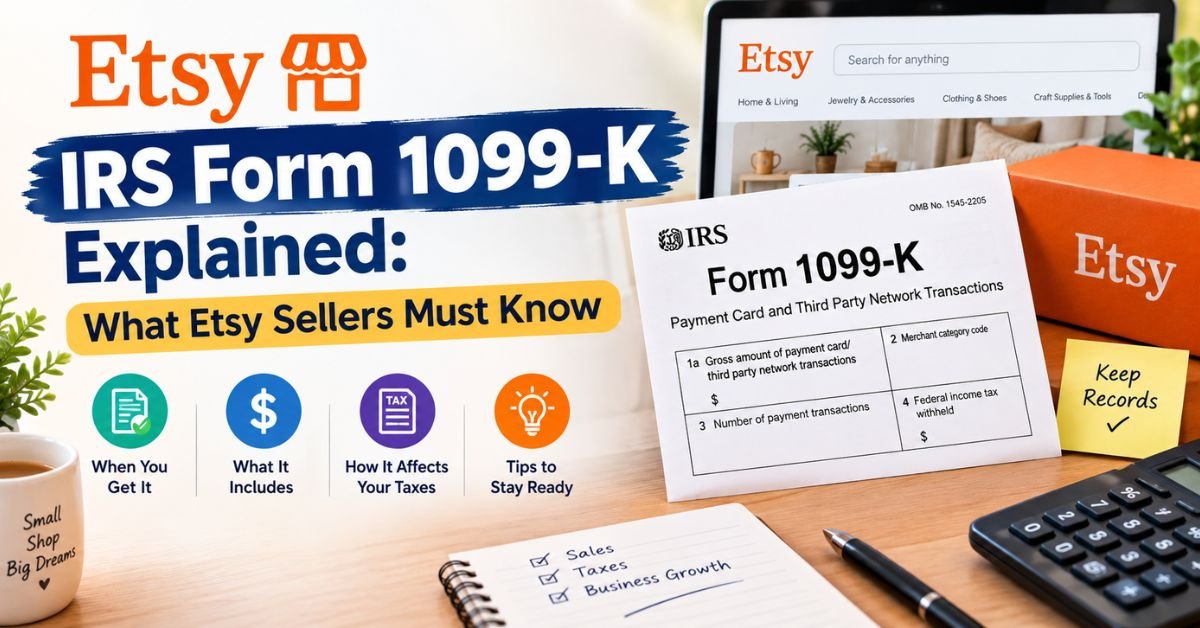
IRS Form 1099-K Explained: What Etsy Sellers Must Know
October 6, 2026
Written By team taxnookly
Our goal is to provide reliable, helpful, and up-to-date content based on practical tax and bookkeeping principles.
In this guide, our team at Tax Nookly will show you, step by step, how to read your 1099-K, spot mistakes, and turn it into a clean Schedule C. You will find no jargon and no panic here. So grab your Etsy statements, and let’s go.
IRS Form 1099-K reports your gross Etsy Payments for the year. That means the total before fees, refunds, labels, and supplies. However, it is not your profit and not a tax bill.
Etsy must send one only if you pass $20,000 AND more than 200 transactions in a year. Some states set lower limits. If you get no form, you still report every dollar on Schedule C. In the end, you pay tax on net profit, not on the 1099-K total.
What Is IRS Form 1099-K?
Form 1099-K is a receipt the IRS keeps for your shop. Etsy sends one copy to you and one to the IRS. Together, they show how much money moved through your account.
The form doesn’t know your costs. For example, it has no idea about the $340 you spent on resin.
Here’s a craft way to picture it. Your sales are a bolt of fabric. The 1099-K tells the IRS the length of the whole bolt, while your expenses are the pieces you cut away. Then Schedule C shows what’s left.
You’ll usually find your tax documents under Shop Manager > Finances. Etsy renames menus often, so search the Help Center if you can’t spot them.
For a complete Etsy-focused overview, see our Etsy 1099-K guide for sellers, including reporting rules, tax forms, and what to do with your 1099-K.
Will You Get a 1099-K From Etsy?
Under the federal rule, a payment platform files a 1099-K when your gross payments pass $20,000 AND you have more than 200 transactions in a calendar year. The One Big Beautiful Bill Act restored this rule, and the IRS confirmed it in Fact Sheet 2025-08. Because rules have shifted before, check the current figure on IRS.gov before you file.
Here’s how that looks:
Your year
Federal 1099-K?
$24,000 from 240 orders
Yes
$24,000 from 150 orders
No
$9,000 from 300 orders
No
Any amount, lower state limit met
Maybe (check your state)
Some states use lower limits, so check your state revenue department’s website.
No form does not mean no tax. The reporting threshold decides who gets a form, but it doesn’t decide who owes tax.
A seller earning $8,000 a year may never see a 1099-K. Even so, that seller still reports the income. If net profit reaches $400, Schedule SE (self-employment tax) applies too.
IRS Form 1099-K Explained, Box by Box
Only a few boxes matter to Etsy sellers.
Box
What it shows
What you do
1a
Gross payments for the year
Compare to your own sales records
1b
Card-not-present transactions
Online sales usually land here
2
Merchant category code
Ignore unless it looks wrong
4
Federal income tax withheld
Rare. Claim it on your return if filled
5a–5l
Gross amount by month
Match to your monthly statements
6–8
State information
Needed if your state has income tax
Box 1a is the big number, and everything else backs it up.
Box 5 helps most. First, match each month to Etsy Payment Account > Monthly Statements. Say January on the form shows $1,180, but your statement shows $1,140. In that case, you’ve found a $40 gap worth chasing.
Etsy tracks money in. You track money out.
Why Your 1099-K Number Looks Too High
Seeing $14,820 when you expected less? That’s common. The form counts gross payments, and those can include money that was never yours.
Say your Box 1a shows $14,820. It might break down like this:
$12,900 from item sales
$1,420 in shipping buyers paid
$500 in sales tax Etsy collected for the state
Form 1099-K can include sales tax, which isn’t your income. It also ignores refunds. If you refunded $420, the form still counts the original payment, so you subtract refunds yourself.
My first instinct was to call the 1099-K the final word. Scratch that. Treat it as the starting line, and treat your own books as the finish.
The IRS Already Has This Number
Your 1099-K total sits in IRS computers. If your return shows less income with no explanation, expect a letter.
Instead, report the income. Then subtract real costs on Schedule C, in the open.
From 1099-K to Schedule C: A Worked Example
This shop is made up. We use it so you can see the flow.
Say your 1099-K shows $14,820. Your records show:
Item
Amount
Gross receipts (items + shipping)
$14,320
Sales tax collected (not income)
$500
Refunds you issued
$420
Etsy fees (listing, transaction, processing)
$1,780
Shipping labels
$1,310
Supplies
$2,950
On Schedule C, you report $14,320 in gross receipts and $420 in returns. After that, you list $6,040 in expenses (fees + labels + supplies).
Net profit: $14,320 − $420 − $6,040 = $7,860.
Next comes Schedule SE. Self-employment tax runs 15.3% on 92.35% of net profit. Here that’s about $7,259 × 15.3%, or roughly $1,111. (Check IRS.gov for current Social Security wage limits.)
Your expenses are the thread holding your profit together. If you miss them, you pay tax on money you never kept.
For deductions, read IRS Pub 334 and Pub 535. A home office uses Form 8829, and its rules are specific.
What If You Never Get a 1099-K?
Is the income invisible? No. Is reporting it still your job? Absolutely.
Here’s what I’d do without a form:
Download all twelve statements from Etsy Payment Account > Monthly Statements.
Add deposits and fees in a free Google Sheet.
Pull sales tax totals from your shop reports.
Total your expenses from receipts and bank statements.
That’s your whole return, form or no form.
You should also plan for quarterly payments. Form 1040-ES is how self-employed sellers pay estimated tax during the year. To avoid an underpayment penalty, check the IRS safe-harbor rules.
How to Fix a 1099-K That Looks Wrong
Maybe a payment counted twice. Maybe you sold personal items on the same account.
Follow this order:
Compare Box 5 monthly amounts to your statements.
Find the exact payments that look off.
Ask Etsy for a corrected form if the error is theirs.
Save screenshots and emails in one folder.
If no correction arrives, report the form’s number on your return. Then show the adjustment with a clear explanation. Personal items sold at a loss usually aren’t business income, but the steps depend on your situation.
Is it annoying? Yes. Is it fixable? Almost always.
Track Your Numbers All Year
The best 1099-K plan starts in January, not April.
A cheap setup works well:
A free Google Sheet with tabs for income, expenses, and mileage
A 15-minute monthly habit: download your Etsy statement and log it
A separate business checking account
Want automation? QuickBooks Self-Employed tags bank transactions for you. However, it costs money, and a spreadsheet works fine at your income level. I’d start with the sheet. Then upgrade if you hate typing.
Each January, match your yearly total to Box 1a. If they differ by more than a few hundred dollars, find out why before you file.
FAQs
What is IRS Form 1099-K used for?
A payment platform reports gross payments received. The IRS then uses it to check that your reported income matches what moved through your account.
Is the full 1099-K amount taxable?
No. You pay tax on net profit. First, report gross receipts on Schedule C. Then subtract refunds and business expenses.
Is Etsy a good place to sell personal items?
Personal items sold for less than you paid usually aren’t taxable income. Still, keep your original receipts and check IRS.gov for how to report them.
Can I get a 1099-K if I’m under the threshold?
Possibly. Some states have lower limits, and platforms sometimes issue forms early. Either way, you owe tax on shop income.
When does Etsy send the 1099-K?
By the end of January, platforms must send forms to sellers. After that, check your Etsy tax documents area to download yours.
Your 10-Minute Homework
Open Etsy Payment Account > Monthly Statements and download last month’s statement. Next, add its total deposits to a new Google Sheet tab named “Income 2026.” With that, you’ve started your 1099-K paper trail.
Sources and Further Reading
We built this guide from official IRS pages. Check them for the latest figures before you file.
Tax Nookly shares general education for US sellers. This is not tax, legal, or financial advice. Tax rules change, and your situation is unique. Check IRS.gov or talk to a licensed tax professional before you file.
Author Bio
About Team Tax Nookly
Team Tax Nookly is a dedicated group of bookkeeping professionals and e-commerce tax specialists focused exclusively on the Etsy marketplace. We simplify complex tax regulations and provide actionable financial strategies to help Etsy sellers manage their businesses with complete confidence.









1 thought on “IRS Form 1099-K Explained: What Etsy Sellers Must Know”